
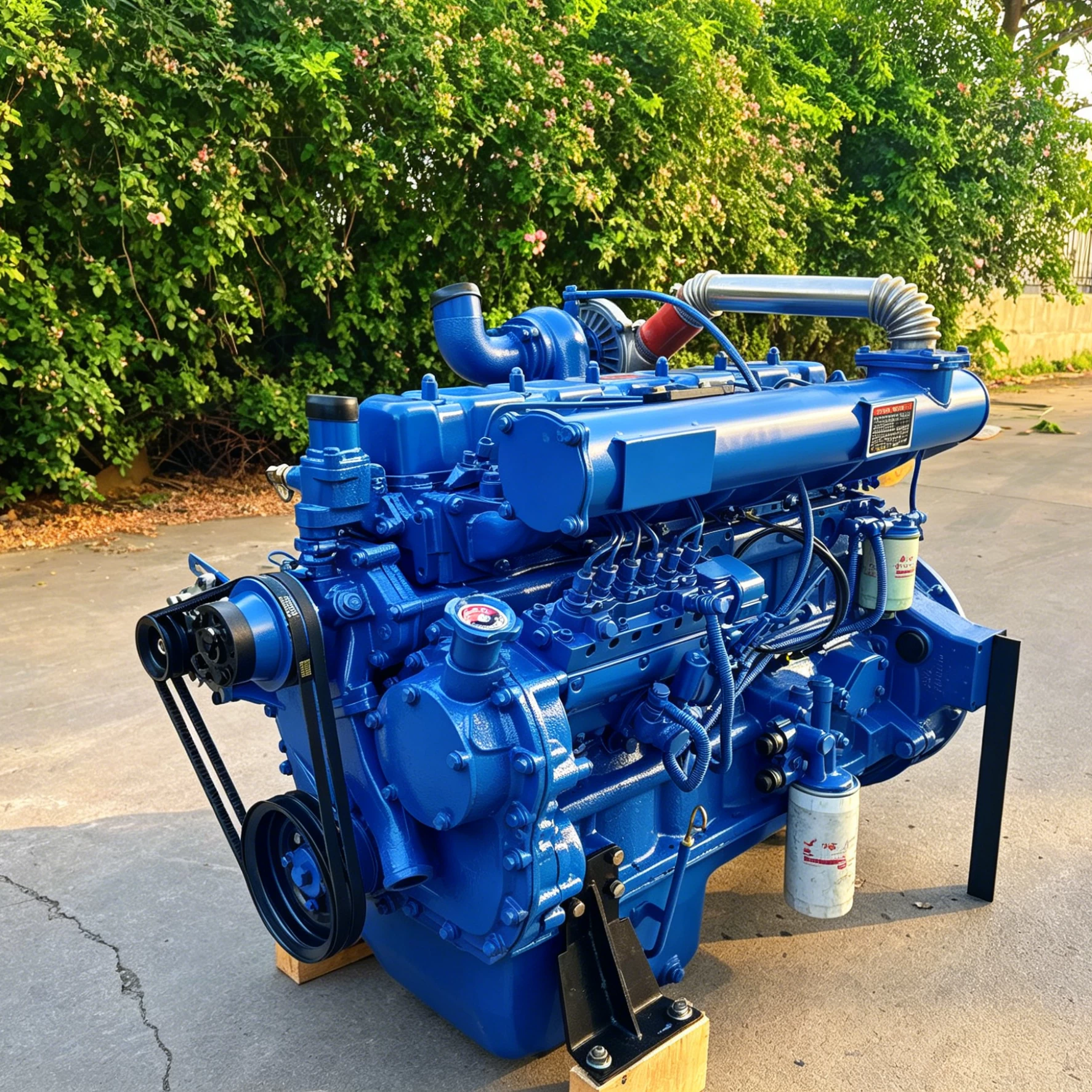
1. What Is an Open-Type Diesel Generator Set?
An open diesel generator set is one of the most basic industrial generator configurations.
The diesel engine, alternator, control system, cooling system and base frame remain relatively exposed without a soundproof enclosure.
This simple structure offers several advantages.
Easier Maintenance
Technicians can access the engine, alternator and major components more easily.
This is useful for industrial users who perform regular inspections and maintenance.
Better Heat Dissipation
The open structure allows good airflow around the generator.
When installed in a properly ventilated generator room, this configuration can support stable operation.
Lower Initial Equipment Cost
Because an open-type generator does not require a complicated acoustic enclosure, its initial cost is generally lower than a silent model with a similar power configuration.
Suitable for Indoor Generator Rooms
Open generator sets are often selected when the customer already has a dedicated machine room with ventilation, exhaust and noise-control systems.
2. Where Are Open Diesel Generators Commonly Used?
Open generator sets can be suitable for applications such as:
Factories
Industrial plants
Mining facilities
Pump stations
Equipment rooms
Manufacturing workshops
Remote industrial facilities
If noise is not a major concern and the generator will operate in a protected environment, an open generator set can be a practical solution.
However, additional weather protection may be required for outdoor installation.
3. What Is a Silent Diesel Generator?
A silent diesel generator places the main generator components inside an acoustic enclosure.
The enclosure is designed to reduce operating noise while still allowing the generator to receive cooling air and discharge heat.
A typical silent enclosure may include:
Sound-absorbing materials
Ventilation openings
Air inlet and outlet systems
Exhaust treatment
Maintenance doors
Weather-resistant panels
Internal control access
Silent generator sets are particularly useful where noise control is important.
4. Applications for Silent Diesel Generator Sets
Silent generators are commonly considered for:
Residential Areas
Backup generators installed near apartments or residential communities may require reduced operating noise.
Hospitals
Hospitals require reliable emergency power, but excessive generator noise may be undesirable around patients and medical facilities.
Office Buildings
Commercial buildings often require backup electricity while maintaining a relatively quiet environment.
Hotels
Hotels may use standby generator systems to support critical electrical loads during grid failures.
Telecommunications
Telecommunication facilities may require standby generators located close to populated areas.
Schools and Public Buildings
Noise control can also be important in schools, government buildings and other public facilities.
5. Silent Generator vs Open Generator: Main Differences
| Factor | Open Generator | Silent Generator |
|---|---|---|
| Noise Control | Lower | Higher |
| Maintenance Access | Very convenient | Through enclosure doors |
| Initial Cost | Usually lower | Usually higher |
| Weather Protection | Limited without additional shelter | Better with suitable enclosure |
| Typical Location | Generator room / industrial site | Indoor or outdoor applications |
| Appearance | Industrial | More enclosed and integrated |
The correct choice depends on the installation environment.
A silent generator is not automatically better than an open generator.
If the customer already has a dedicated generator room, an open model may be more economical.
If the generator will be installed outdoors near people, a silent enclosure may provide important practical advantages.
6. What Is a Trailer-Mounted Diesel Generator?
A trailer diesel generator is designed for applications where the power source must move between different locations.
The generator set is installed on a trailer chassis that can be transported by an appropriate vehicle.
Depending on the project, the trailer configuration can include:
Wheels
Towing structure
Support legs
Weatherproof enclosure
Fuel tank
Cable connections
Control panel
Trailer-mounted generator sets are especially useful for temporary and mobile projects.
7. Where Are Trailer Generators Used?
Typical applications include:
Construction Sites
Construction projects frequently change power locations as work progresses.
A mobile generator can provide electricity for tools, temporary buildings and site equipment.
Mining Operations
Mining and crushing operations may require power in remote areas where the electrical grid is unavailable.
Road and Infrastructure Projects
Temporary power may be required for road construction, tunnels, bridges and other infrastructure work.
Emergency Power
Mobile generator sets can be transported to locations affected by power failures or emergencies.
Outdoor Projects
Events, field operations and temporary industrial activities may also require portable power.
8. Open vs Silent vs Trailer Generator: How Should You Choose?
A simple way to choose is to start with the working environment.
Choose an Open Generator If:
The generator will be installed in a machine room.
Noise is not a major concern.
Easy maintenance access is important.
The installation location provides weather protection.
You want a simpler industrial configuration.
Choose a Silent Generator If:
Noise reduction is important.
The generator is installed near residential or commercial areas.
Outdoor protection is required.
A cleaner enclosed appearance is preferred.
Choose a Trailer Generator If:
The generator must frequently change locations.
You operate construction or mining projects.
Temporary power is required.
Mobility is more important than permanent installation.
For some projects, a trailer-mounted generator can also use a silent enclosure, combining mobility with reduced noise.
9. What Is an Automatic Standby Generator?
Many factories, hospitals, commercial buildings and critical facilities use generators primarily during grid failures.
In these applications, automatic starting can be valuable.
An automatic standby generator system can be configured to detect a mains power failure and start the generator according to the control system design.
When normal grid power returns, the system can transfer the load back according to the selected configuration.
This reduces dependence on manual generator operation during emergencies.
10. Why Automatic Standby Power Matters
Consider a production factory.
If the electrical grid suddenly fails, critical equipment may stop immediately.
Manual generator starting may require personnel to:
Identify the outage.
Reach the generator room.
Start the generator.
Confirm output.
Transfer the electrical load.
An appropriately designed automatic standby system can simplify this process.
Automatic standby power can be useful for:
Factories
Hospitals
Data facilities
Banks
Telecommunications
Commercial buildings
Residential developments
The exact transfer and control configuration should be designed according to the customer's electrical system.
11. What Is a Parallel Diesel Generator System?
One large generator is not always the best solution.
Some facilities use two or more generator sets operating through a parallel control system.
Parallel generator systems can provide several advantages depending on the project.
Flexible Capacity
Multiple generators can be used according to changing power demand.
Redundancy
If one generator requires maintenance, other units may remain available depending on the system configuration.
Expansion
Additional generating capacity may be easier to add in some projects.
Load Management
Multiple units can help support different load conditions more efficiently when properly designed.
Parallel operation requires suitable control, synchronization and protection systems.
For this reason, the complete electrical load and operating strategy should be discussed with the generator supplier.
12. Calculate the Required Generator Power Correctly
Generator configuration is important, but power sizing remains fundamental.
Simply adding the rated wattage of every electrical device may not provide an accurate generator specification.
Buyers should consider:
Continuous load
Maximum load
Motor starting current
Pumps
Compressors
Crushers
Elevators
Air-conditioning equipment
Future expansion
Operating reserve
Motors can require significantly more power during starting than during normal operation.
This is especially important in construction, mining, water pumping and industrial applications.
Providing a detailed equipment list allows the supplier to recommend a more suitable generator capacity.
13. Consider the Operating Environment
A diesel generator should be configured for the actual installation location.
Important environmental factors include:
Ambient Temperature
High temperatures may affect cooling performance.
Altitude
High-altitude locations can affect diesel engine performance and may require project-specific evaluation.
Dust
Mining, crushing and construction sites can have high dust levels.
Humidity
High-humidity or coastal environments may require additional consideration for electrical and metal components.
Rain and Outdoor Exposure
Outdoor installations require appropriate weather protection.
Providing these conditions during the inquiry stage helps the manufacturer configure the generator more accurately.
14. Fuel Tank Requirements
Fuel capacity depends on the operating strategy.
A standby generator operating only during occasional outages has different requirements from a generator providing continuous electricity at a remote construction site.
Buyers should consider:
Expected operating hours
Fuel availability
Refueling frequency
Site space
Local safety requirements
An appropriately sized fuel system can reduce unnecessary interruptions during operation.
15. Consider Maintenance Access
Even a high-quality diesel generator requires routine maintenance.
Regular service may include checking or replacing:
Engine oil
Oil filters
Fuel filters
Air filters
Coolant
Belts
Hoses
Batteries
The generator configuration should provide adequate space for technicians to perform these tasks.
When planning a generator room, do not install equipment so close to walls that normal maintenance becomes difficult.
16. Information to Send When Requesting a Generator Quote
For a more accurate quotation, prepare the following information:
Required Power:
kW or kVA if already known.
Application:
Factory, construction, mining, hospital, building, marine or another application.
Load Equipment:
Motors, pumps, compressors, lighting, machinery or other electrical equipment.
Use Type:
Prime power or standby power.
Generator Type:
Open, silent, trailer-mounted or another configuration.
Voltage:
Required output voltage.
Frequency:
50 Hz or 60 Hz.
Phase:
Single-phase or three-phase.
Operating Environment:
Indoor, outdoor, high altitude, dusty, humid or other conditions.
Destination Country:
Important for project configuration and transportation.
17. Why Custom Generator Configuration Matters
Industrial customers do not all need the same generator.
A construction company may prioritize mobility.
A hospital may prioritize automatic standby capability.
A factory may prioritize stable continuous output.
A residential development may prioritize noise reduction.
A mining operation may require a rugged configuration suitable for harsh environments.
For this reason, generator selection should begin with the application rather than simply selecting a standard machine from a catalog.
Yihai Power Generator Solutions
Shandong Yihai Power Machinery Co., Ltd. provides diesel power solutions for industrial and commercial applications.
Depending on customer requirements, generator systems can be configured in different forms, including open-type, silent enclosure, trailer-mounted, automatic starting and multi-unit parallel solutions.
Applications can include factories, construction projects, mining, buildings, hospitals and other common or standby power scenarios.
Conclusion
There is no single diesel generator configuration suitable for every project.
The right solution depends on:
Required power
Installation location
Noise requirements
Mobility
Automatic operation
Load characteristics
Environmental conditions
Maintenance requirements
For indoor industrial generator rooms, an open generator may be practical.
For commercial or residential environments, a silent generator may be more suitable.
For construction and temporary projects, a trailer-mounted generator can provide greater flexibility.
Need help configuring a diesel generator set?
Send Yihai Power your required power, load equipment, application, voltage, frequency, installation environment and destination country. Our team can help evaluate a suitable generator configuration for your project.